DICE: Disentangled Instance-Class knowlEdge Prompt Tuning via SAE for Vision-Language Models
Abstract
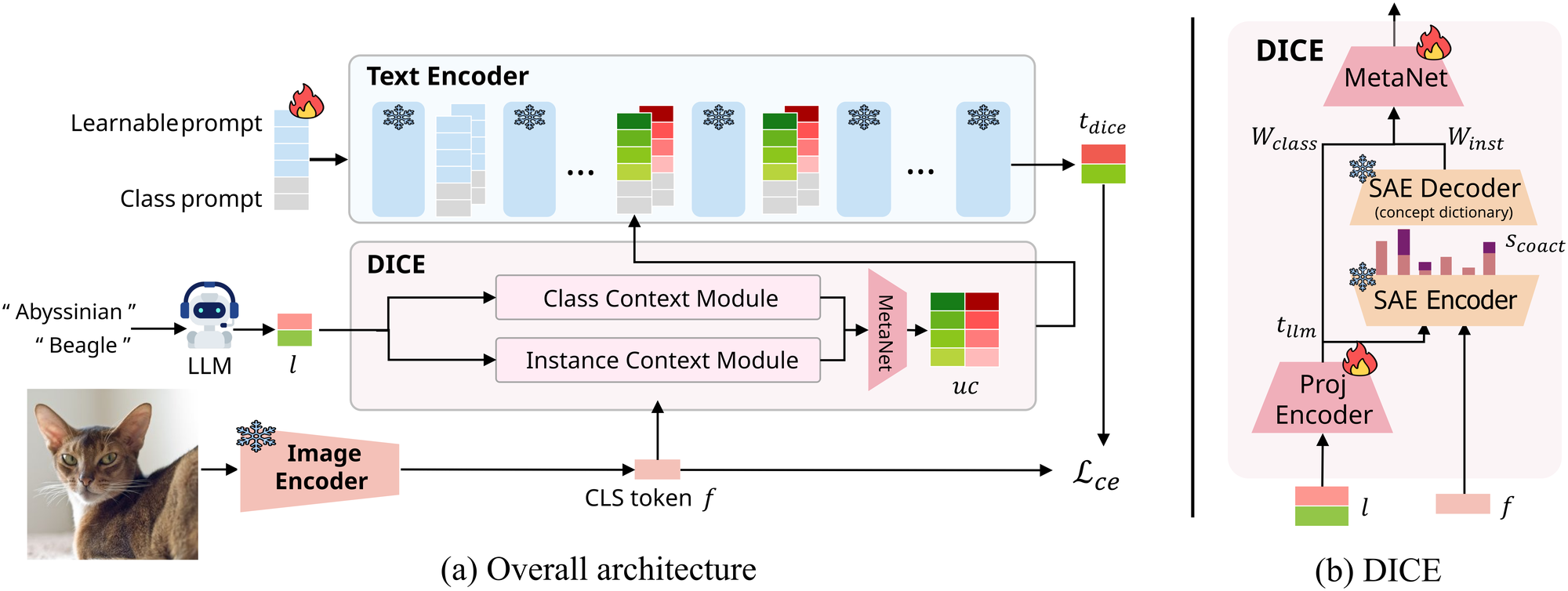
CLIP, known for its strong zero-shot generalization, has received significant attention in prompt tuning for its ability to adapt effectively to new tasks in few-shot settings. Recent studies have employed descriptions generated by Large Language Models (LLMs) as predefined prompts to obtain class-level semantics. However, because these predefined descriptions are not directly grounded in visual information, they often misalign with an image's visual semantics. They tend to generate generic class-level descriptions rather than instance-specific ones. As a result, LLM-based prompts are structurally biased toward class-level semantics, making it difficult to capture and reflect instance-level cues, which in turn limits generalization in few-shot settings where both levels of knowledge are crucial. To address this limitation, we propose Disentangled Instance-Class knowlEdge (DICE) prompt tuning, a framework that restructures LLM-derived class-level priors to capture instance-level semantics. Specifically, DICE decomposes LLM-derived priors into instance-level components using a Sparse Autoencoder (SAE), which selects instance-specific concept vectors. These concept vectors are then fused with class embeddings to form enriched representations. This synergy preserves class-level semantic coherence while capturing instance-level details, improving generalization to unseen classes. Our approach achieves competitive performance across 11 few-shot recognition benchmarks, while additionally offering a plug-and-play solution that enhances interpretability through SAE.
Motivation
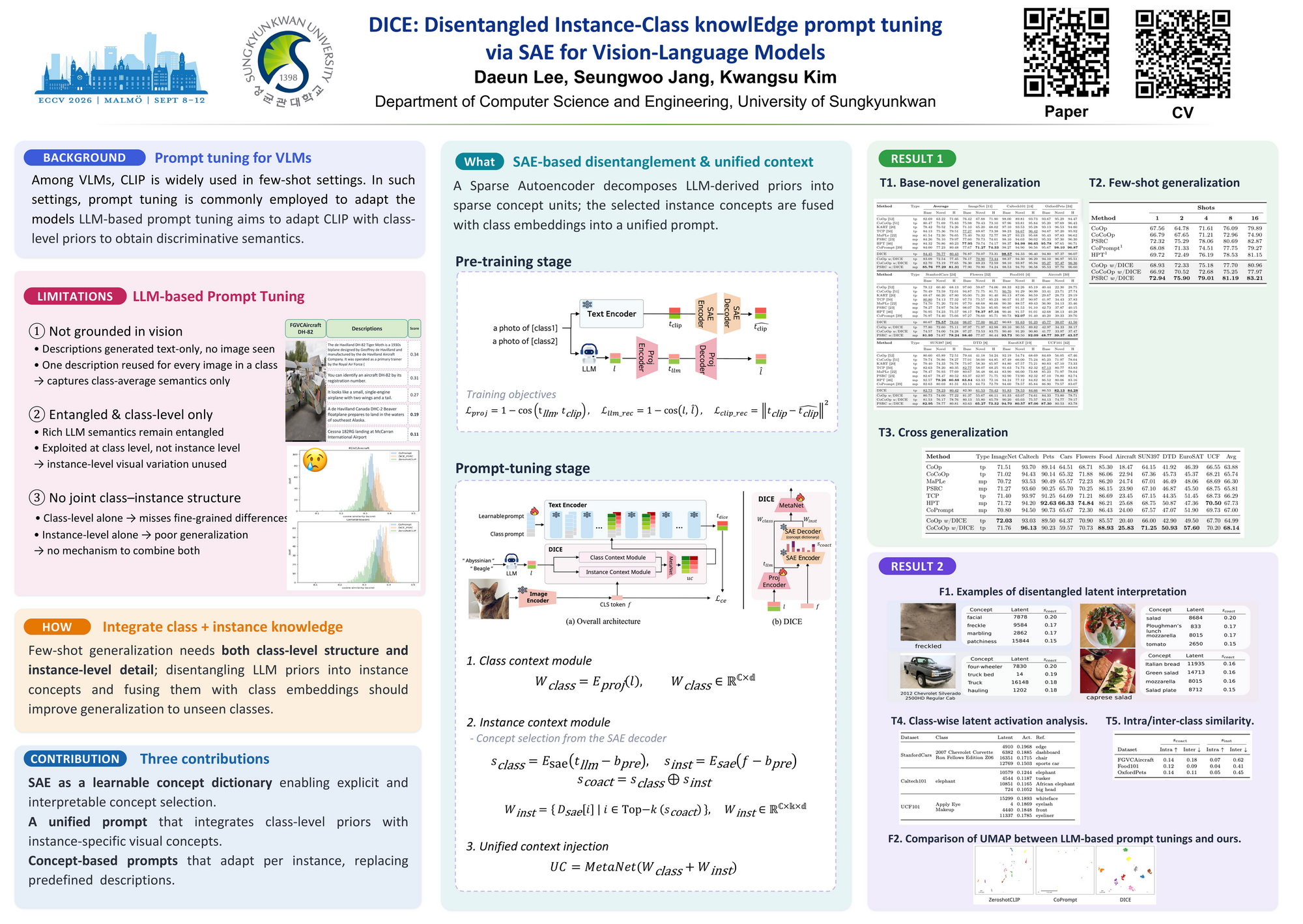
A single LLM-generated class description is reused for every image in a class, regardless of visual differences. As shown below, many descriptions align poorly with the actual image (left), and across datasets the cosine-similarity distribution has a pronounced left tail for prior methods (right). DICE shifts this distribution to the right, strengthening visual–textual alignment by injecting instance-specific concepts.
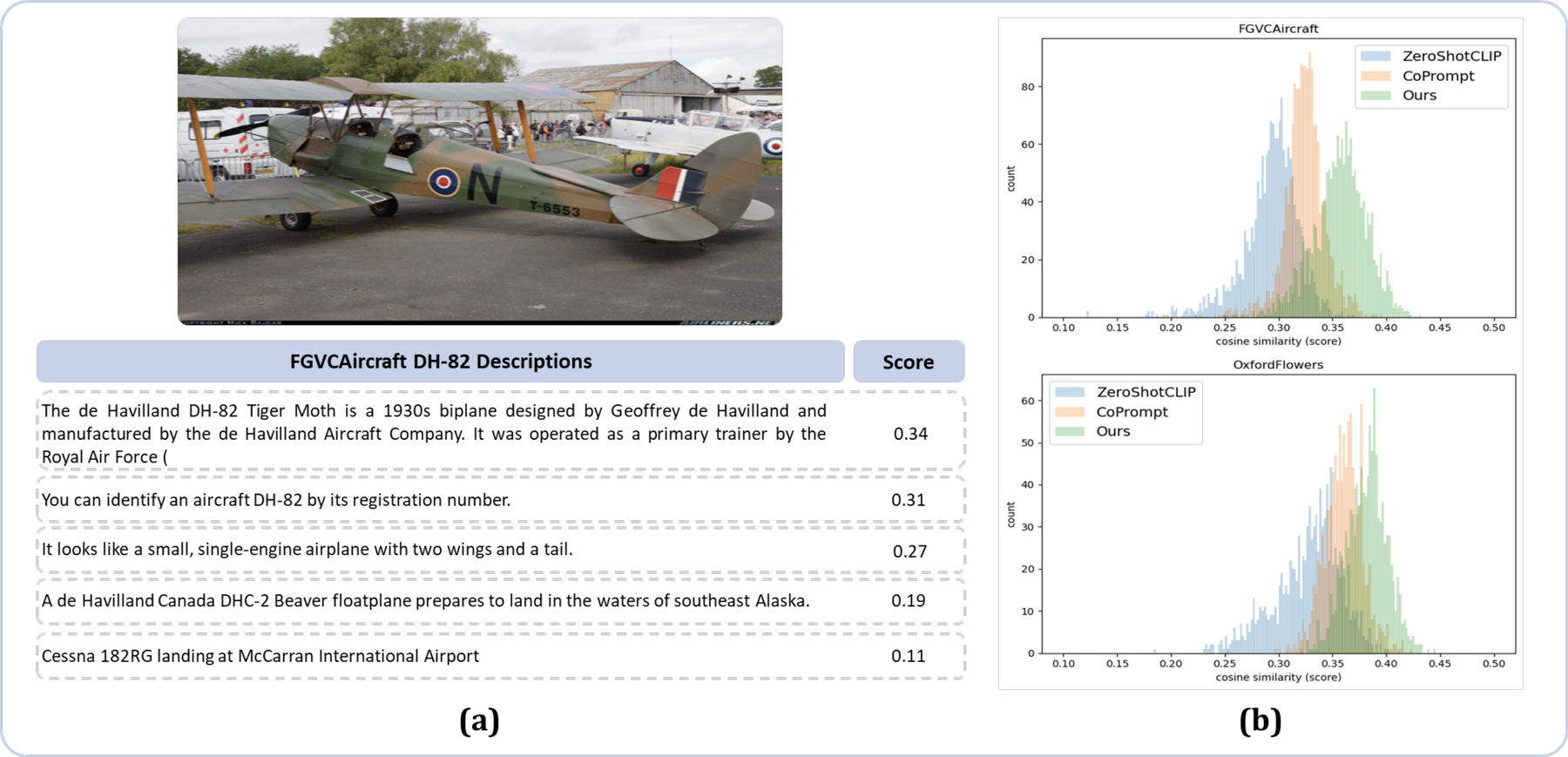
(a) Cosine similarities between LLM-generated descriptions of class DH-82 and its image in FGVC-Aircraft. (b) Similarity distributions for ZeroshotCLIP, CoPrompt, and DICE (Ours).
Method
DICE builds a unified context prompt from two complementary branches. The Class Context Module projects cached LLM embeddings into the CLIP space to capture general class-level semantics. The Instance Context Module passes both the projected class embedding and the image feature through a shared Sparse Autoencoder (SAE), computes a co-activation score over the sparse concept dictionary, and selects the top-k concept vectors aligned with both the image and its class. The two branches are fused and passed through a lightweight meta-network to produce prompts that reflect both general class knowledge and instance-specific detail.
Contributions
- Concept Dictionary via Sparse Autoencoders. We show that an SAE can serve as a learnable concept dictionary for vision–language representations, enabling explicit concept selection and improving interpretability.
- Class–Instance Semantic Integration. We introduce a unified prompt formulation that integrates class-level semantic priors with instance-specific visual concepts for robust few-shot adaptation.
- From Handcrafted Descriptions to Concept-based Prompts. We replace predefined class descriptions with prompts built from disentangled concept units that adapt dynamically to each input instance.
Results
Base-to-Novel Generalization (average over 11 datasets)
DICE sets a new state of the art among single-textual-prompt methods (Base/Novel/H = 84.45 / 76.77 / 80.43) and, as a plug-and-play module, lifts CoOp/CoCoOp/PSRC by up to +5.79 H. PSRC w/ DICE reaches the best overall harmonic mean of 81.31, surpassing recent LLM-based and multi-modal prompt tuning methods.
| Method | Type | Base | Novel | H |
|---|---|---|---|---|
| CoOp | tp | 82.69 | 63.22 | 71.66 |
| CoCoOp | tp | 80.47 | 71.69 | 75.83 |
| TCP | tp | 84.13 | 75.36 | 79.51 |
| MaPLe | mp | 81.54 | 72.30 | 76.65 |
| PSRC | mp | 84.26 | 76.10 | 79.97 |
| HPT | mp | 84.32 | 76.86 | 80.23 |
| CoPrompt | mp | 84.00 | 77.23 | 80.48 |
| DICE (Ours) | tp | 84.45 | 76.77 | 80.43 |
| CoOp w/ DICE | tp | 83.09 | 72.54 | 77.45 |
| CoCoOp w/ DICE | tp | 82.70 | 73.19 | 77.65 |
| PSRC w/ DICE | mp | 85.76 | 77.29 | 81.31 |
tp: text prompt tuning · mp: multi-modal prompt tuning · H: harmonic mean.
Few-shot Classification (accuracy vs. #shots, avg. over 11 datasets)
| Method | 1 | 2 | 4 | 8 | 16 |
|---|---|---|---|---|---|
| CoOp | 67.56 | 64.78 | 71.61 | 76.09 | 79.89 |
| CoCoOp | 66.79 | 67.65 | 71.21 | 72.96 | 74.90 |
| PSRC | 72.32 | 75.29 | 78.06 | 80.69 | 82.87 |
| CoOp w/ DICE | 68.93 | 72.33 | 75.18 | 77.70 | 80.96 |
| PSRC w/ DICE | 72.94 | 75.90 | 79.01 | 81.19 | 83.21 |
Ablations
| Setting | Base | Novel | H |
|---|---|---|---|
| Class only | 84.28 | 75.78 | 79.80 |
| Instance only | 82.52 | 74.34 | 78.22 |
| Class + Instance | 84.45 | 76.77 | 80.43 |
Both context modules are complementary.
| Setting | Base | Novel | H |
|---|---|---|---|
| w/ SAE | 84.45 | 76.77 | 80.43 |
| w/o SAE (MLP) | 81.31 | 73.82 | 77.38 |
| Δ | +3.14 | +2.95 | +3.05 |
Gains stem from sparse concept disentanglement, not extra capacity.
Interpretability: Disentangled Concepts
Each SAE latent is matched to its most strongly activated WordNet concept. Meaningful and diverse concepts emerge (e.g., freckled for skin texture, mozzarella for food), and even images within the same class emphasize distinct but related concepts — evidence that the SAE captures interpretable, instance-level variation.
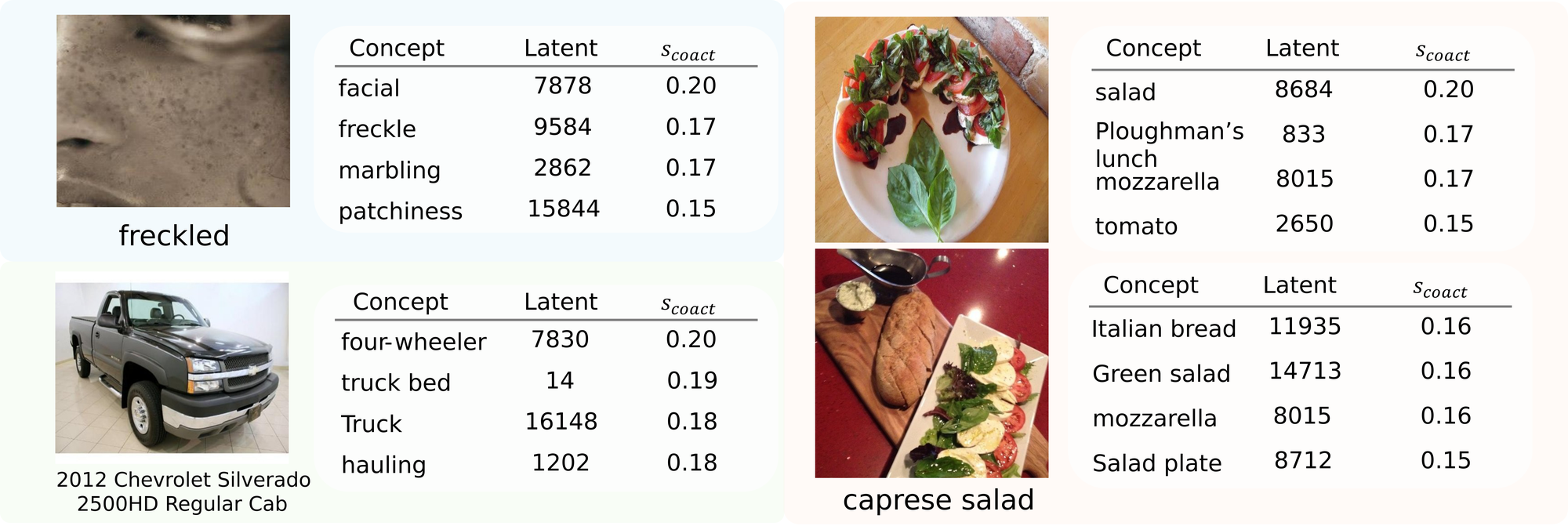
Disentangled latent interpretation on DTD (top left), StanfordCars (bottom left), and Food101 (right). Each image activates a distinct, interpretable set of concept latents.
Food101: per-image concept activations.
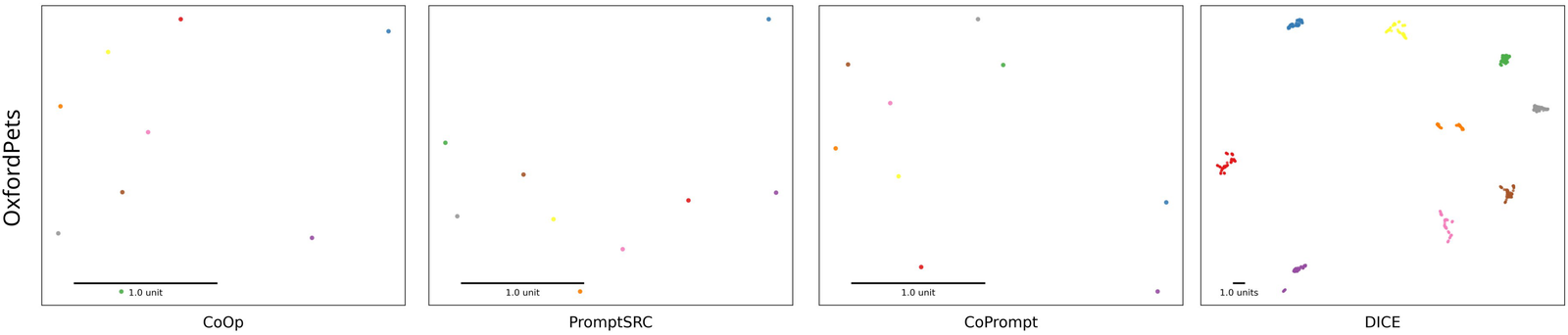
OxfordPets: per-image concept activations.
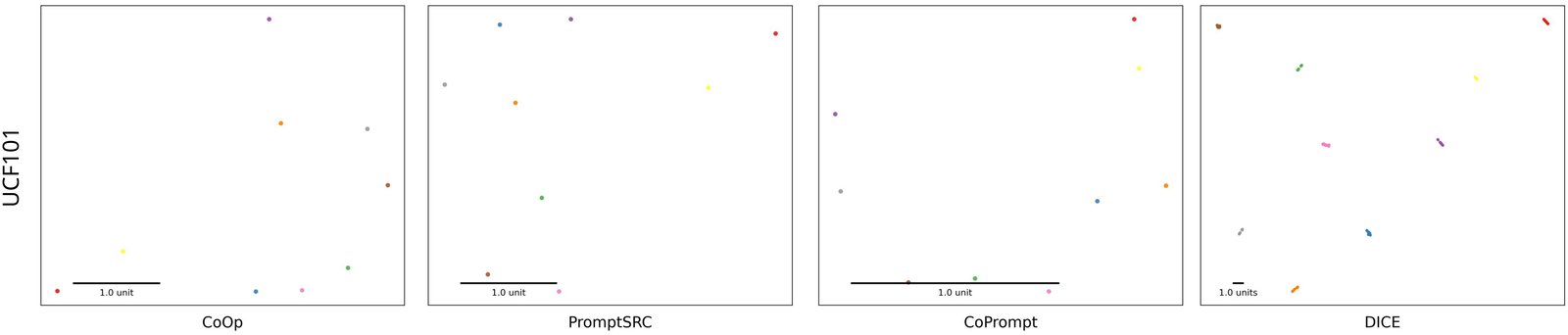
UCF101: per-image concept activations.
Representation Quality (UMAP)
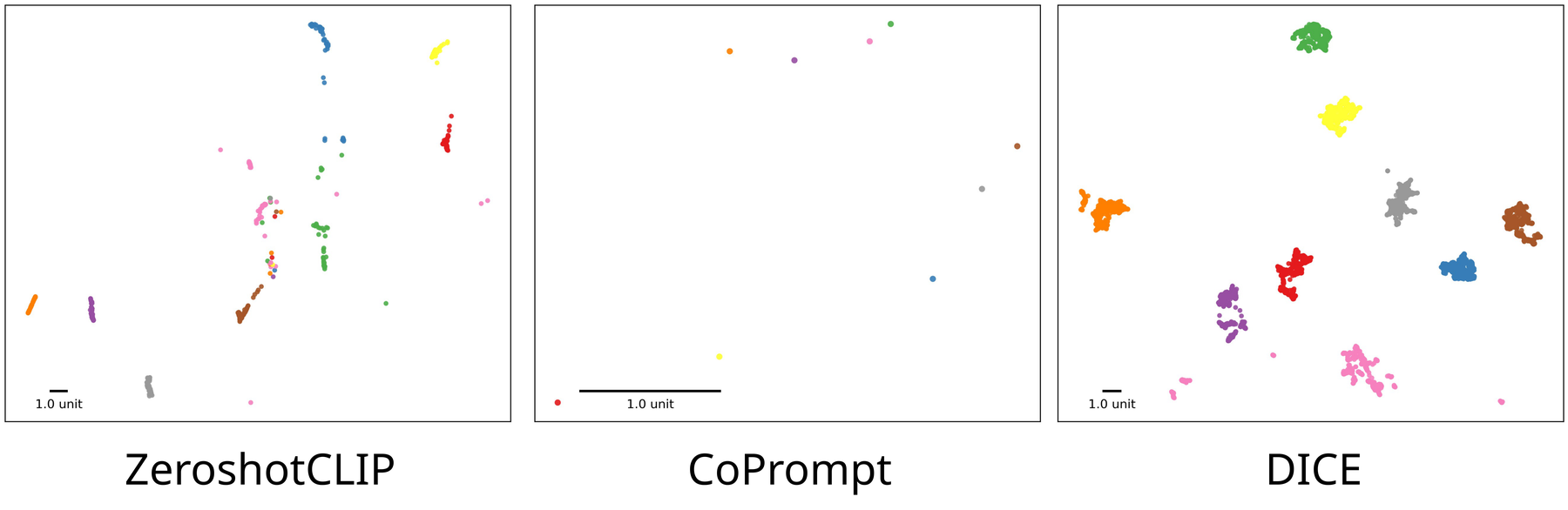
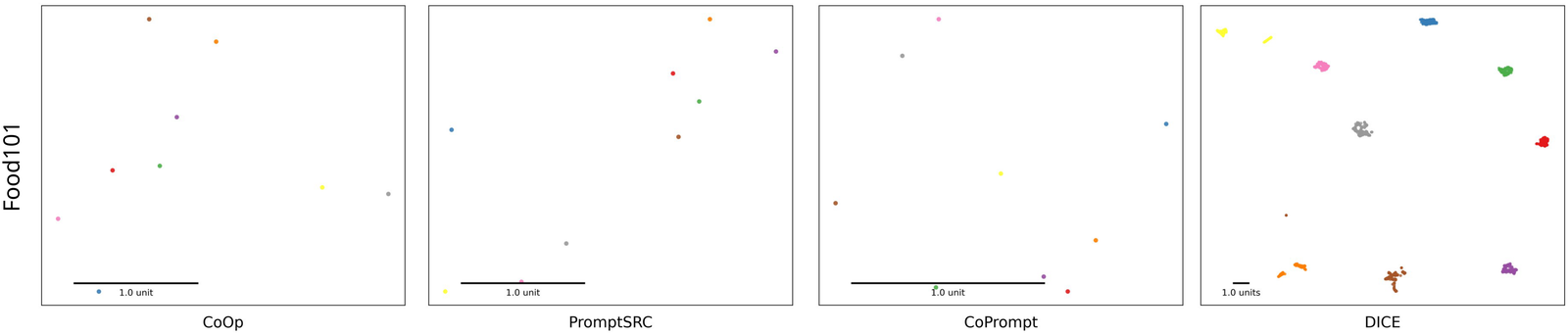
On FGVC-Aircraft, DICE produces well-separated clusters with clear inter-class boundaries, unlike the scattered ZeroshotCLIP embeddings and the low-variance CoPrompt clusters.
Poster
ECCV 2026 · Thu, Sep 10, 10:30–12:30 CEST · ExHall #461
Code and citation will be available soon.